

Why Guinness 0.0 Is Hard to Find Right Now (and What That Says About Demand)
Guinness 0.0 has been playing hide-and-seek in Central Massachusetts—at bars and on store shelves. Using Boland’s and Shuggy as the on-the-ground lens, this piece looks at how demand gets created fast, distribution catches up unevenly, and why local availability can reveal a bigger story.
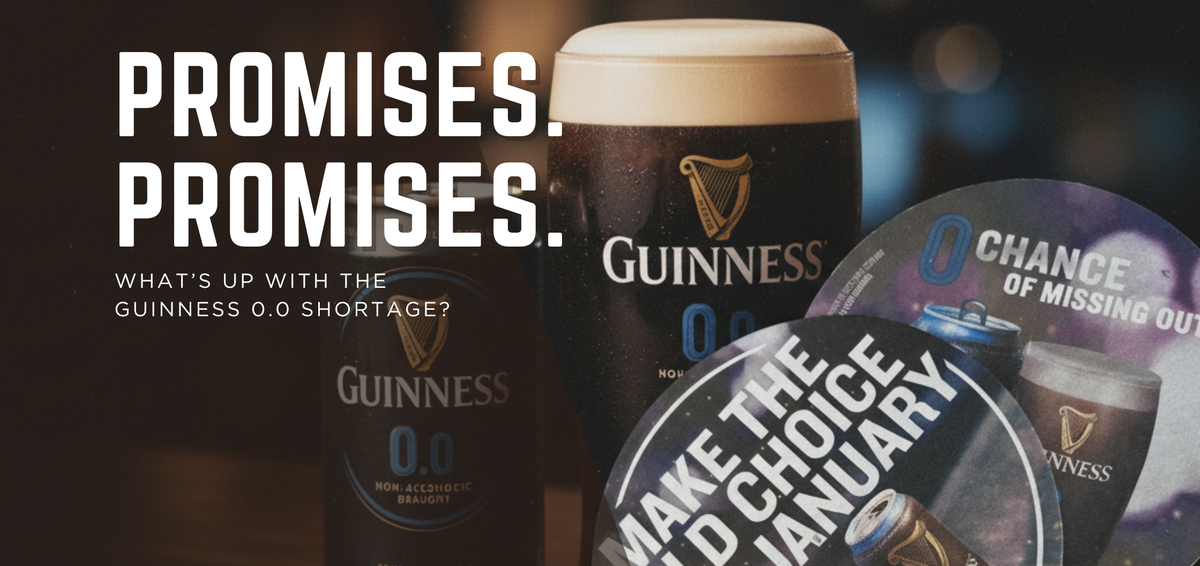
Settle in. THIS pint won’t drink itself.
I usually end posts with that line. This time, I thought I'd flip it around because THIS PINT of 0.0 might not be drunk at all — especially if you can't find it.
The field report: “it’s been weeks”
Here in Central Massachusetts, Guinness 0.0 has started to feel like a rumor: someone saw it, somewhere, but not many.
Local shelves are where national demand shows up first.
More than one on-premise operator has told me the same thing: they simply can’t get Guinness 0.0 through normal distribution right now. And here’s the part that matters—retail isn’t a dependable fallback either. When it shows up, it’s often in small quantities and disappears quickly.
That’s not a complaint about one missed delivery. That’s a pattern.
Shuggy’s version of the problem (and why it matters)
If you’ve read enough of my pub stories, you already know Shuggy. He’s not a “Dry January” guy. He’s an “every month has regulars” guy.
And for weeks now, his message has been consistent: he can’t reliably get Guinness 0.0 through normal distribution. Not “we ran out once.” Not “we forgot to order.” Weeks.
That matters because it’s the difference between a seasonal fad and a real operational headache. Guinness 0.0 isn’t a novelty in a place like this—it’s a way to keep the ritual intact for people who want the taste and the belonging without the alcohol. It's become as much a part of early morning Liverpool matches as the bounty of red scarves in the room.
A small, perfect example from the front lines
At Boland’s, they've had Guinness 0.0 beer mats on the tables all month.
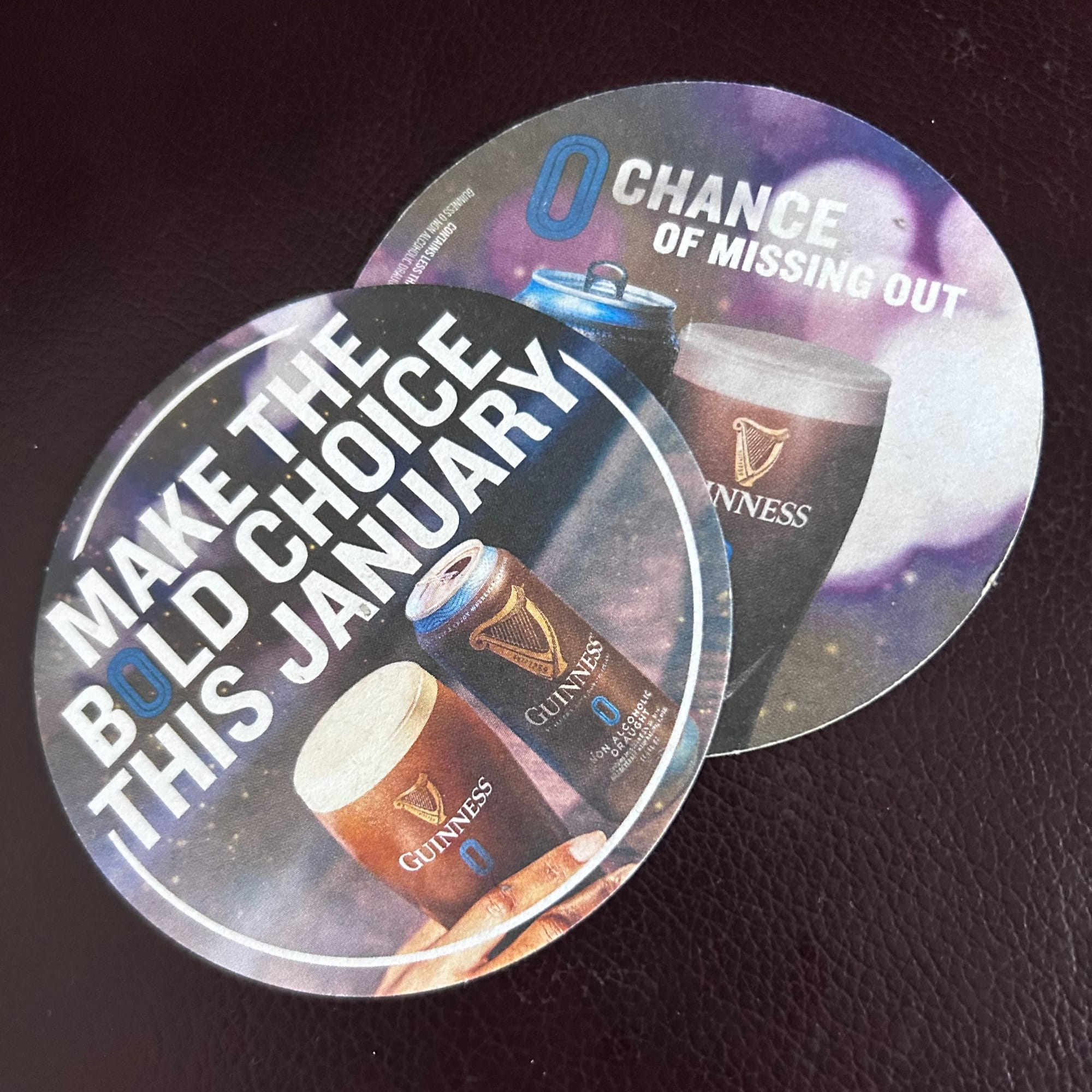
Not subtle ones, either:
- “MAKE THE BOLD CHOICE THIS JANUARY”
- “0 CHANCE OF MISSING OUT”
That’s a brand spending money to push the idea right where the ritual happens.
And it’s also where the irony shows up: Boland’s hasn’t been able to get Guinness 0.0 consistently. So the “0.0 slot” on the night sometimes gets filled by Heineken 0.0 instead.
That’s the story in miniature: demand is being actively created, but local availability can’t always meet the moment.
This isn’t just a Dry January fad
It would be easy to shrug and blame Dry January. And sure—January is when non-alcoholic beer gets a marketing megaphone.
But the more interesting point is that Guinness 0.0 isn’t a once-a-year novelty for many bars and regulars. It’s become a “keep the ritual” option: the pint glass, the head, the taste—without the alcohol. Match mornings, music nights, designated drivers, early shifts, training cycles… the reasons aren’t seasonal.
So when a product with predictable, year-round demand goes missing, it’s usually not because one month got trendy. It’s because the system that normally keeps it stocked can’t catch up.
The most likely explanation: demand spike + distribution lag
Here’s the cleanest way to think about what’s happening—without turning it into conspiracy or drama.
- Demand has grown fast. Guinness 0.0 has become a default choice for people who still want the Guinness ritual.
- January amplifies that demand. Dry January doesn’t create the whole market, but it can absolutely stress-test it.
- Distribution doesn’t pivot instantly. Even if production is fine overall, supply moves in cycles: forecasts, allocations, warehouse inventory, delivery windows. When demand jumps, some regions feel it first.
- Retail scarcity is a signal. If it’s not just missing from distributor orders but also hard to find on store shelves, that’s a sign the tightness is real at the local level.
In other words: this looks less like “they stopped making it” and more like “the system can’t refill fast enough where demand is densest.”
Why this matters (beyond the can)
I care about this story for the same reason I care about pubs in the first place: they’re not just places that sell drinks. They’re community infrastructure.
A music night. A match morning. A friend who wants to stay out late but wake up clear. A regular who wants the taste and the belonging without the buzz.
Guinness 0.0 isn’t a substitute for Guinness. It’s a way to keep the ritual intact. Guinness 0.0 IS Guinness.
And when it disappears, you notice—because it’s not just a product missing from a shelf. It’s an option missing from the room.
A question for the room
If you’ve tried to find Guinness 0.0 recently—at a bar, a package store, or a grocery run—what are you seeing?
- Is it consistently available where you are?
- Is it “sometimes” available, but in tiny quantities?
- Is it gone entirely?
Drop your city/region (no need to name specific stores) and roughly when you last saw it. I’m trying to understand whether this is a short-lived January squeeze—or a longer-term signal that demand has outgrown distribution planning.
– Mike


Comments ()