

A Guinness Glossary
A companion guide to the language, ritual, and culture found throughout Pints and Power.
The Purpose of This Guide
Guinness carries its own language. Some of it is technical, shaped by brewers and bartenders. Some belongs to the pub: rituals, habits, small acts that speak louder than words. And some comes from the people who gather around the pint, passing along stories, slang, memories, and the quiet rules that give the drink its weight.
This guide serves as a companion to Pints and Power. It’s not a marketing glossary or a collector’s checklist. It’s a way to understand the world that the pint has shaped, and the ways people speak about it. The terms here reflect history, pouring traditions, varieties of the beer itself, and the culture that forms wherever Guinness is poured. Many appear in the book. Others come from the wider world that sits around it.
Use it as a reference. Use it as a doorway. Or use it as a reminder that Guinness is more than a drink. It is a vocabulary of belonging.
Enjoy the glossary even more as a companion to your own copy of Pints and Power.
Section 1 — The Pint Itself
Guinness
Ireland’s most recognized stout, defined by its nitrogen pour and cultural weight.
The Pint
1) Shorthand for Guinness in most Irish contexts. 2) The standard serving of Guinness, an imperial pint, not the American measure. It holds 20 imperial ounces (568 ml), making it larger than the 16-ounce U.S. pint.
The Perfect Pint
A well-executed two-part pour in a clean glass with a proper settle and balanced dome.
Two-Part Pour
The standard ritual: pour to the harp, wait, then top up.
Settle
The 90 second wait between the first pour and the top off. Nitrogen molecules rise and fall, the cloudy cream clears to reddish black, and the ritual earns its patience.
Surge
The falling and rising motion created by nitrogen bubbles.
Dome
The curved head rising above the rim.
Head / Cream
The protective layer of nitrogen foam that seals the pint.
Nitrogen (Nitro)
Gas blended with CO₂ to create Guinness’s texture.
Nitro Surge
At-home device designed to mimic a proper bar pour.
Stout
Dark beer style built on roasted barley.
Black Stuff
Informal name for Guinness.
The Good Stuff
Praise for a well-poured pint.
Guinness 0.0
Nonalcoholic Guinness retaining the flavor profile and ritual.
Guinness Extra Stout
Sharper, bottle-conditioned stout.
Foreign Extra Stout
Stronger export stout designed for durability and distance.
West Indies Porter
Modern interpretation of early Guinness export recipes.
Antwerpen Stout
Belgian-market stout brewed since the 1940s.
Citra IPA
A nitrogen-served Guinness experiment outside the stout category.
Gravity Glass
Modern Guinness glass introduced in 2010 with a contoured shape.
Enjoy the glossary even more as a companion to your own copy of Pints and Power.
Section 2 — Pouring Ritual and Technique
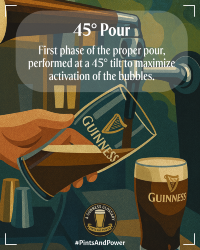
45° Pour
The first phase of a proper pour, performed at the proper tilt to maximize activation of the bubbles.
Harp Line
Fill mark for the first stage.
Top-Up
Vertical pour that completes the head.
The Push
Backhand motion used to top up.
The Pause
Essential wait between the two stages.
119.5 Seconds
Guinness’s formal pour timing.
First Sip
Breaking the head and beginning the pint.
The Bite
The deliberate first gulp through the head, filling our mouth with foam and stout
Guinness Mustache
Cream on the upper lip after the first sip.
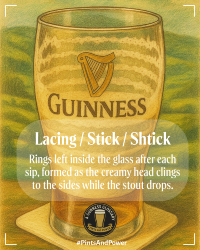
Lacing / Stick / Shtick
Rings left inside the glass after each sip, formed as the creamy head clings to the sides while the stout drops.
Clean Lines
Properly maintained gas and beer lines between the keg and tank to the tap.
Virgin Glass
A spotless glass ensuring a stable head.
Presentation
How the pint is placed on the bar.
Enjoy the glossary even more as a companion to your own copy of Pints and Power.
Section 3 — Glassware and Tools
Tulip Pint Glass
Classic Guinness shape with a mid-bulge.
Guinness Tulip
Common reference to the traditional tulip glass.
Oversized Tulip
Larger version of the classic tulip.
Conical Pint
Straight-sided glass not ideal for Guinness.
Top Shelf Glass
Personal glass for a specific regular.
Vintage Guinness Glassware
Older logoed or mismatched glasses treasured for memory.
Collector’s Glass
Limited-run glasses tied to specific events.
Engraved Glass
Custom or commemorative glass.
Widget
Plastic device in cans of Guinness Draught, designed to to release nitrogen by bouncing the molecules free from the liquid as pressure is released.
Nitro Can
Guinness can brewed for nitrogen pours at home.
Enjoy the glossary even more as a companion to your own copy of Pints and Power.
Section 4 — Pub Language and Traditions
The Local
Your chosen pub, based on belonging rather than distance.
Public House (Pub)
Communal social space central to Irish life.
The Snug
Small enclosed area for privacy and quiet conversation.
Session / Seisiún
Gathering for music or shared time.
Craic
Fun, atmosphere, or lively banter.
Lock-In
After-hours gathering inside a pub.
Regulars
Consistent patrons who give a pub its identity.
Publican
Owner or steward of the pub.
House Pint
The specific pour style of that pub.
Quiet Corner
A place in the pub for reflection or small conversation.
Pint of Plain
A traditional Irish phrase meaning a pint of Guinness. Popularized by Flann O’Brien’s poem The Workman’s Friend, which declared that “a pint of plain is your only man.” Still used with affection in pubs across Ireland.
Enjoy the glossary even more as a companion to your own copy of Pints and Power.
Section 5 — People and Voices
Arthur Guinness
Founder of Guinness and signer of the 9,000-year lease.
Arthur Guinness II
Expanded the brewery in the early 19th century.
Benjamin Lee Guinness
Led major civic improvements in Dublin.
Edward Cecil Guinness
Fourth generation head of Guinness who modernized in the late 19th century and became one of Ireland’s most influential philanthropists, using Guinness wealth to fund housing, public works, and social reform efforts across Dublin. Later the 1st Earl of Iveagh,
Rupert Guinness
The 2nd Earl of Iveagh, fifty generation family leader who oversaw Guinness’s global expansion in the early 20th century.
Arthur Edward Guinness
Modern Guinness family figure tied to philanthropy, 4th Earl of Iveagh.
Rory Guinness
Chair of the Iveagh Trust and contemporary family voice.
Michael Ash
Scientist, brewer and inventor of the nitrogenation drought system for delivering pints of Guinness.
Fergal Murray
Master Brewer known for modernizing the pour’s global standardization.
Niall Connelly
Folk singer-songwriter whose work carries themes of memory and place.
Danny O’Reilly
Frontman of The Coronas and voice of a modern Irish musical identity.
Enjoy the glossary even more as a companion to your own copy of Pints and Power.
Section 6 — History and Context
St. James’s Gate
The Dublin home of Guinness since 1759.
9,000-Year Lease
Arthur Guinness’s symbolic act of confidence in the brewery’s future.
Easter Rising
Historical rebellion referenced near the brewery’s grounds.
Marrowbone Lane
District around the brewery tied to 1916 history.
Diageo
Modern corporate parent of Guinness.
Irish Diaspora
Global community carrying Irish ritual and culture abroad.
The Troubles
Northern conflict in which pubs remained central social spaces.
Neutral Pub
Pub known for remaining open to all sides during the conflict.
Enjoy the glossary even more as a companion to your own copy of Pints and Power.
Section 7 — Advertising, Art, and Memorabilia
Gilroy Ads
20th-century advertisements featuring animals and humor.
The Toucan
Guinness’s most famous advertising mascot.
Guinness Zoo
Group name for the animals in John Gilroy’s famous 20th century Guinness advertising campaigns.
World Traveller Memorabilia
Collectibles from Guinness’s mid-century travel program.
Guinness Mirrors
Decorative pub mirrors used around the world.
Tap Handles
Distinctive Guinness handles tied to different eras.
Ephemera
Smaller branded items collected over time: coasters, matchbooks, and more.
Enjoy the glossary even more as a companion to your own copy of Pints and Power.
Section 8 — Geographic Locations
St. James’s Gate, Dublin
The site of the Guinness brewery since 1759 and the industrial center of the Guinness enterprise.
Leixlip
A small village in Co. Kildare where Arthur began life as a brewer by acquiring the lease to the small brewery near the Salmon Leap four years be for moving to St. James‘s Gate.
Farmleigh House, Phoenix Park, Dublin
Former Guinness family residence acquired by Edward Cecil Guinness and later gifted to the Irish state.
Iveagh House, Dublin
Former residence of the Earls of Iveagh, now home to Ireland’s Department of Foreign Affairs.
St. Stephen’s Green, Dublin
Public park restored and gifted to the city by Arthur Guinness, Lord Ardilaun.
Iveagh Gardens, Dublin
Public gardens donated by Edward Cecil Guinness, 1st Earl of Iveagh, located near Harcourt Street.
The Iveagh Trust Housing, Dublin
Working-class housing developments funded by Guinness wealth, still in use today.
Lough Tay (Guinness Lake), County Wicklow
Estate landscape long associated with the Guinness family in the Wicklow Mountains.
Ashford Castle Estate, County Mayo
Large estate formerly owned by the Guinness family, reflecting their role within Irish landed society.
Elveden Hall (Elveden Estate), Suffolk, England
A large country estate in Suffolk owned and developed by Edward Cecil Guinness, 1st Earl of Iveagh, and today the home of the 4th Earl of Iveagh.
Enjoy the glossary even more as a companion to your own copy of Pints and Power.