

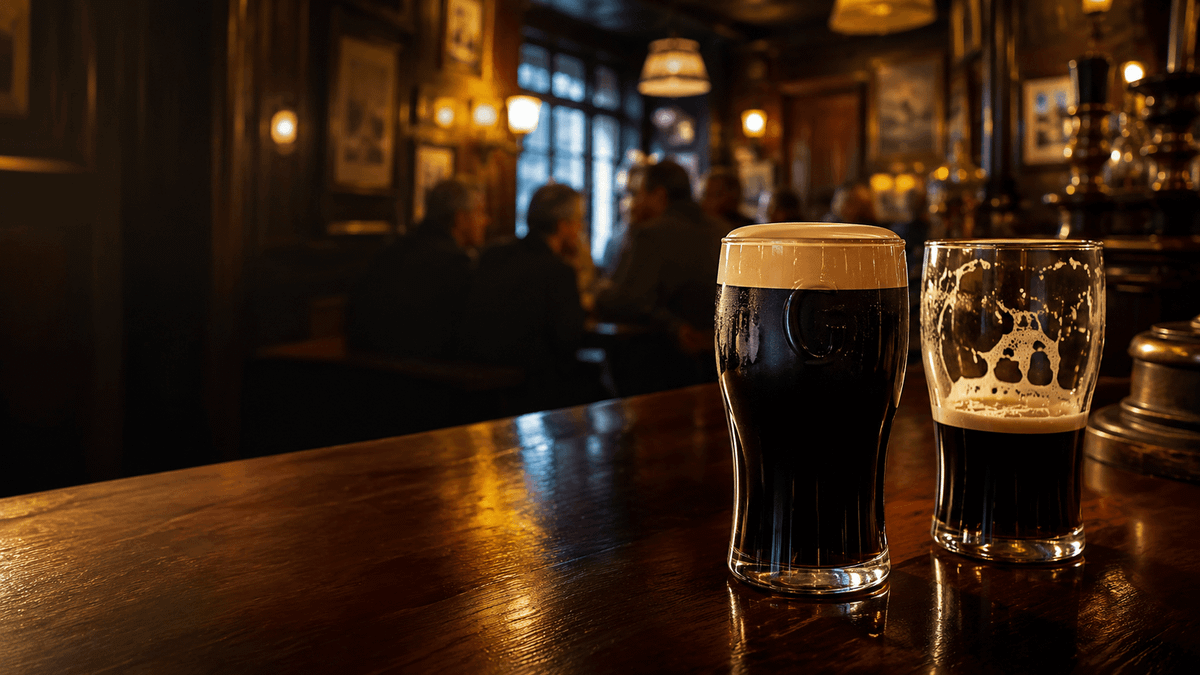
For all its dark appearance and creamy weight, Guinness Draught is surprisingly restrained by modern beer standards. It’s not just calories or alcohol content. It’s nitrogen, ritual, and the rhythm of the Irish pub. Guinness was the original “light beer” long before the term.
For decades, people have looked at a pint of Guinness and assumed the same thing:
Heavy beer.
The pint looks substantial. Black as turf smoke. Thick creamy head. Slow settle. It arrives with the gravity of a meal and the pace of a ceremony.
And yet, Guinness Draught sits at roughly 4.2% ABV and around 210 calories in a full imperial pint. By modern standards, that’s remarkably restrained. Plenty of pale craft beers people casually call “easy drinking” carry far more alcohol, more sugar, and more calories.
So why does Guinness still feel heavier?
Because what people are experiencing usually has less to do with chemistry than ritual.
Guinness Carries Weight Differently
Most modern beer culture is built around intensity:
- stronger
- hoppier
- colder
- faster
- more extreme
Guinness evolved in almost the opposite direction.
Nitrogen softens the pint instead of sharpening it. The bubbles are smaller. The carbonation bite is reduced. The beer settles instead of exploding across the palate. Even physically, it often leaves people feeling less bloated than highly carbonated lagers or IPAs.
Carbonation attacks.
Nitrogen settles.
That’s the genius of Guinness. The beer feels rich without behaving aggressively.
The pint asks you to slow down.
And somehow, in slowing down, it gains emotional weight.
The Pint Was Built for Staying
Guinness was never really designed to dominate the room. It was designed to remain in it.
That matters in Ireland.
The Irish pub was never simply a place to consume alcohol. It was a place to remain present:
- after the match
- after the funeral
- after work
- after the music started
- after the difficult conversation finally arrived
Guinness fit that rhythm perfectly because it wasn’t trying to race anyone anywhere.
You can feel it in the two-part pour. Even now, in an age built around immediacy, Guinness still insists on waiting. The settle matters. The pause matters.
The pint creates space before the conversation even begins.
Even “Splitting the G” Proves the Point
Now admittedly, modern Guinness culture has introduced a slight complication to this whole “slow down” philosophy.
Splitting the G.
For the uninitiated, the challenge is simple enough: take the first sip perfectly so the beer line lands precisely through the middle of the “G” on the Guinness logo.
Which usually means downing nearly a third of the pint immediately.
On paper, it sounds like the exact opposite of everything I just said.
And yet, every single time I watch it happen, something funny follows.
The person who aggressively attacks the first third of the pint almost always spends the rest of that pint nursing what remains like they’re trying to apologize to it. Tiny corrective sips. Long pauses. Careful handling. Suddenly the pint becomes precious again.
It’s as though they cheated the ritual with the first gulp and spend the next twenty minutes trying to restore balance to the universe.
That’s the strange power of Guinness.
Even when people turn it into a game, the pint somehow drags them back toward presence anyway.
The Myth of the “Heavy Beer”
The biggest misunderstanding about Guinness is that people confuse visual richness with physical heaviness.
Guinness looks dense.
It feels ceremonial.
It carries emotional gravity.
But chemically, it behaves more like a classic session beer than a heavyweight stout.
And maybe that contradiction explains why it survived while so many trends came and went.
Guinness never needed to market itself as a “light beer” because that was never really the point.
The point was always this:
a pint you could stay with.
Not just for one round.
For the whole evening.
For the whole conversation.
Sometimes for an entire lifetime of stories.
That’s a different kind of lightness altogether.
Settle in. THIS pint won’t drink itself.
— Mike


Comments ()