

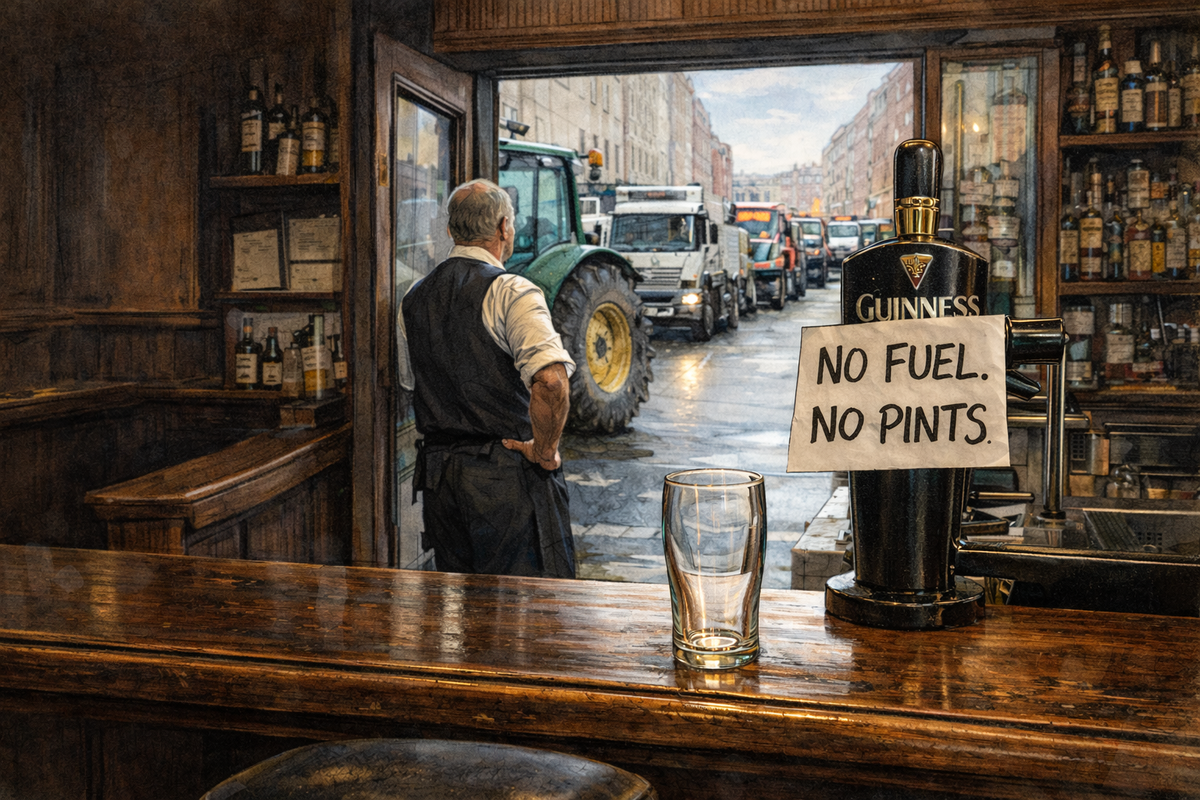
Fuel blockades don’t just disrupt deliveries. They threaten the pub’s social fabric, and they remind us that Guinness has long been more than a drink. It’s leverage, ritual, and a kind of quiet currency.
There’s a particular kind of Irish panic that doesn’t look like panic at all. It looks like someone leaning on a bar, scanning the taps a little longer than usual, doing the math in their head. Not about euros. About pints.
The last couple of weeks in Ireland have seen fuel protests and blockades disrupt deliveries across Ireland, pubs, especially in parts of Dublin, started whispering the unthinkable: What if the Guinness doesn’t make it in?
One report captured the mood with a line that lands like a bell at last call: a pub worker said they were “down to their last keg of Guinness by lunchtime.” The coverage reads less like a nationwide collapse and more like a localized, time-sensitive supply disruption. But that’s the point. It doesn’t take a full-blown shortage to rattle the country. It only takes the credible threat of one.
 Rory McGinn
This is not about a “fix”
It’s tempting, especially from the outside, to frame this as a simple consumer story: drinkers want their pint, and they get cranky when it’s gone. But that misses what Guinness is doing in Ireland.
Guinness is part of the staging of the pub, and the pub is not just a bar. It’s meeting house, cultural center, social club, bulletin board, confessional, and living room. It’s where news travels, where grief gets held, where celebrations get stitched into memory. The pint sits at the center of that room like a small, dark anchor.
 Jayde Maher
So when Guinness is threatened, the fear is not only “I can’t get what I want.” The fear is “what happens to the room?” If the pub’s role collapses, Ireland loses something that makes it uniquely itself in the world, a public space that still knows how to be human.
A modern supply chain story, told in stout
Fuel blockades don’t just slow traffic. They interrupt the invisible choreography that keeps a small island stocked: tankers, depots, distribution schedules, and the daily routes that turn a brewery’s output into a pub’s ritual. When that choreography breaks, the consequences show up in the most public places, behind the bar, in the middle of the room, in the thing everyone can see.
 Maggie Doyle
And Guinness is uniquely visible. If a pub runs out of a niche spirit, the night continues. If a pub runs out of Guinness, the night changes shape. It becomes a conversation. A complaint. A joke that isn’t really a joke. Because Guinness isn’t just a product in Ireland. It’s a shared reference point, something people use to measure whether the world is behaving.
Guinness has altered economic trends before
If this sounds dramatic, it’s because the history supports it.
During World War II, Guinness sat in a strange position: Ireland was officially neutral, and yet Guinness was essential to the morale of British troops. The stout was rationed at home, but kegs still moved abroad. In 1942, when Ireland restricted barley malting and banned beer exports to protect bread supplies, a sudden Guinness shortage in Belfast stirred unrest among British troops.
Then something even more telling happened. Britain moved quickly, arranging a barter: wheat in exchange for stout. Guinness warned it lacked coal to brew enough for both Ireland and export, and the British, eager to keep soldiers supplied, released coal shipments across the Irish Sea. This pattern repeated itself in the run-up to D-Day. Guinness became a bargaining chip, traded for wheat, coal, fertilizer, and machinery.
Read that again, slowly. In a time of rationing and ruin, Guinness wasn’t just a drink. It was leverage.
Read more about this page in the history of Guinness
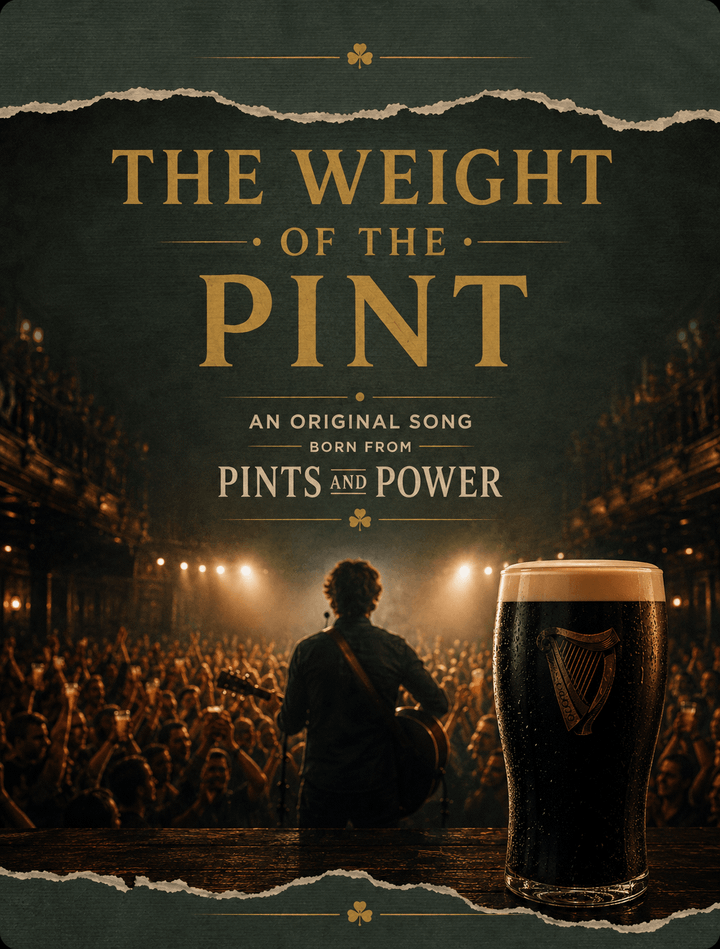
and much more in Pints and Power
The pint as Ireland’s quiet currency
A currency is any widely accepted unit of value that people trust. It doesn’t have to be printed. It doesn’t have to be minted. It just has to be understood.
In Ireland, Guinness functions like a kind of cultural currency:
- It’s a unit of comparison. People talk about the price of a pint the way other countries talk about gas prices or rent.
- It’s a signal. When the pint jumps, it tells you something about wages, energy costs, insurance, and whether a pub can survive.
- It’s a social contract. A round of Guinness isn’t just a purchase, it’s participation. It’s belonging. It’s “I’m here with you.”
That’s why threatened shortages matter even when they’re localized. They don’t just threaten supply. They threaten a shared language.
What the blockades really reveal
The fuel protests didn’t create Guinness’s importance. They exposed it.
When deliveries are disrupted, you see how much of modern life is built on systems we rarely notice, until they fail. And when the threatened shortage is Guinness, you see something else: how a nation can carry its history, identity, and economic anxieties inside a single, ordinary ritual.
A pint is not a policy. It won’t fix a supply chain. It won’t resolve a protest. But it can tell you what people value, what they fear losing, and what still holds a country together when the roads are blocked.
If you want to understand Ireland, watch what happens when the trucks stop.
Settle in. This pint won’t drink itself.
Notes / Sources
- Reporting on fuel protests/blockades and threatened Guinness shortages
(Irish Independent; Limerick Leader; RTÉ News) - Pints and Power: First Pour Edition (WWII section: rationing, Belfast unrest, barter of wheat/coal/fertilizer/machinery for stout)


Comments ()