

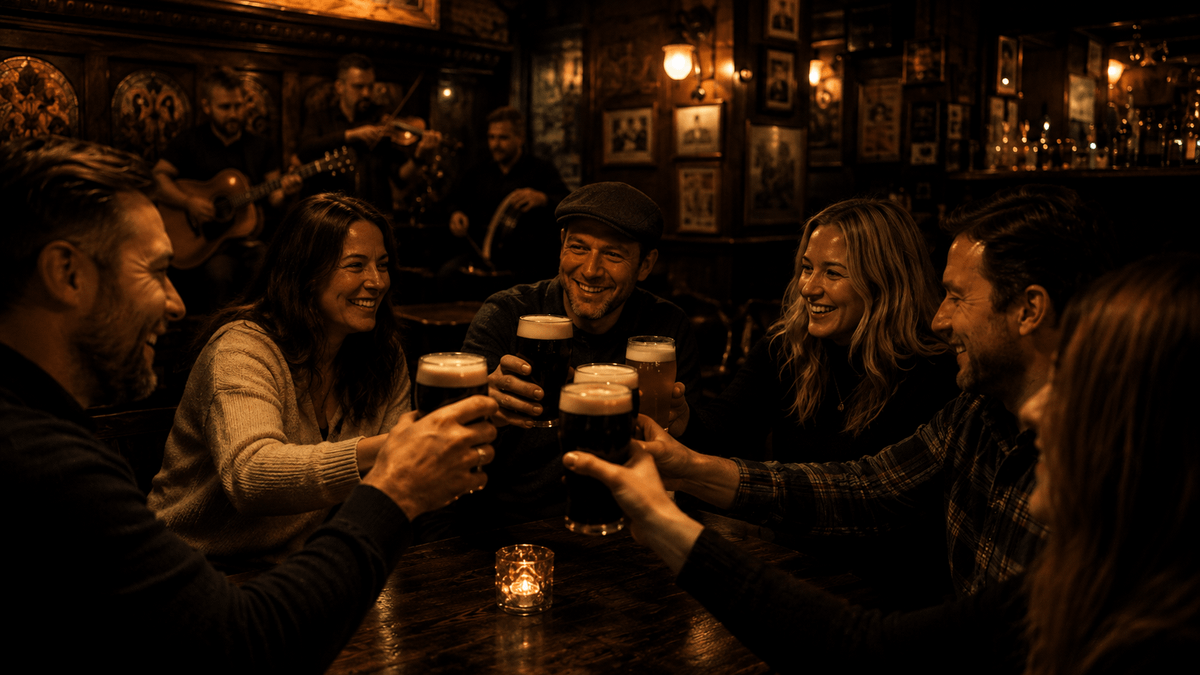
Buying rounds is one of the pub’s simplest rituals, but beneath the pints is something deeper: reciprocity, trust, participation, and the quiet message that you belong.
The Pint We Buy for Each Other
There’s a moment that happens in a good pub that almost never gets announced. A few people settle in, someone takes a quick look around the table, gets up, heads to the bar, and a few minutes later comes back carrying drinks for everyone.
No discussion. No spreadsheet. No Venmo request. Just the first round.
And once it begins, something else begins with it. The music plays, stories get told, someone gets interrupted halfway through theirs, somebody laughs too loudly. The first drinks slowly disappear and, before anyone really needs to ask, another person gets up. The next round arrives, and so it goes, round and round.
It is one of the simplest traditions of the pub, but like so many of the rituals I’ve come to notice while writing Pints and Power, there is more underneath it than first appears.
THE UNWRITTEN LEDGER
In Pints and Power, I describe it this way:
“There’s an unwritten ledger to all of it, but nobody is supposed to look like they’re keeping one.”
That’s really how it works. Nobody writes anything down, but somehow everyone knows. You remember who bought the first one. You have a general sense of when your turn is coming. And if the group grows from three people to six somewhere along the way, you quietly begin recalculating your evening.
The unwritten rule is simple enough: if you’re in the round, eventually it becomes your round. Nobody has to announce it, and nobody should have to.
Of course, that’s where things can get interesting. Two friends buying each other a pint is one thing. Six or eight people doing it is something else entirely. The round is generous and communal, but if you aren’t paying attention, it can also turn a quick visit to the pub into a much longer evening than you had planned.
There are ways to navigate the rhythm without losing the meaning of it.
A FEW THINGS I’VE LEARNED
Getting in early helps. Groups have a way of collecting as the night goes on. Four people at six o’clock can become eight people by nine, and the mathematics start changing quickly.
It also helps to know when to change what’s in the glass. There is absolutely nothing wrong with moving from Guinness to Guinness 0.0, or to soda or water. A good bartender understands the signal, and good friends don’t care. What you are drinking is your business.
There is another side to all of this too. The same reciprocity that makes the round feel generous can create a subtle pressure to keep pace when you probably shouldn’t. That’s one of the tensions I explore in Chapter 8: The Shadow Beneath the Foam: ritual can bring people together, but it should never become an obligation to drink more than you want. Slowing down, changing what’s in your glass, or stopping altogether doesn’t change your place in the group.
And it doesn’t necessarily remove you from the round.
If you’re leaving, buying the next one on your way out is a pretty graceful exit. And if life happens and you have to disappear before your turn comes around, remember it. Next time, get the first one.
Nobody expects perfect accounting. In fact, perfect accounting would probably ruin the whole thing. The round works because there is enough trust between people to believe that, sooner or later, it will come back around.
WHAT ARE YOU HAVING?
That may be my favorite part of the tradition. The question is almost always simple:
“What are you having?”
For a few minutes, one person becomes responsible for the group. Not in some profound or heroic way. They simply get up, walk to the bar, and come back carrying something for everyone. Later, somebody else does the same. The responsibility moves around the table just as naturally as the conversation does.
There is generosity in that, but also reciprocity and belonging.
That’s why another line from the new section of Pints and Power gets closer to what I think is really happening:
“The round isn’t really about alcohol. It’s about participation.”
That becomes obvious when somebody isn’t drinking. Maybe they have a Guinness 0.0. Maybe they have a Coke. Maybe they’re drinking water. They are still part of the round because the important thing isn’t what is in the glass. It is that there is a glass coming back for them too.
The ritual survives because it was never entirely about the alcohol in the first place.
It was about being included.
THE PUB MAKES ROOM FOR IT
That is one of the things the best pubs seem to understand instinctively. They create room for small rituals to become meaningful: the familiar stool, the nod from the bartender, the song everyone knows, the pint poured properly, the friend who gets up before you can ask and comes back carrying your drink.
None of those things are particularly dramatic, and maybe that’s why they matter. The pub doesn’t force connection. It simply creates the conditions where connection can happen, and the round becomes one of the quiet mechanisms that keeps it moving.
You buy mine. I buy yours. Someone new joins us. We make room. The night goes on.
Over time, those little exchanges become part of the texture of the place. They help turn a room full of people into something closer to a community. Not because everyone is keeping score, but because everyone is contributing something.
Sometimes it happens with conversation. Sometimes with a song. Sometimes with nothing more complicated than carrying somebody else’s pint back from the bar.
THE PINT WE BUY FOR EACH OTHER
Of course the rounds never work out perfectly. Someone leaves early. Someone forgets. Someone buys two. Someone insists they bought the last one when everybody else knows perfectly well they didn’t.
That’s part of it too, because the point was never perfect reciprocity. The point was participation.
It is one more example of something I keep coming back to through this whole journey with Pints and Power: the pint itself matters, but what happens around it matters more. A Guinness can be beautifully poured, the glass can be perfect, and the setting can be exactly right, but ultimately the power isn’t only in the pint someone places in front of you.
Sometimes it is in the one you get up to buy for somebody else.
And maybe “What are you having?” is just another way of saying something the best pubs have always understood:
You’re with us.
Settle in. THIS pint won't drink itself.
– Mike


Comments ()